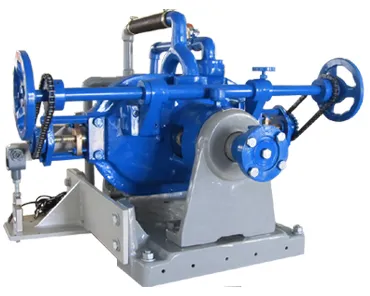
Technomech offers high-performance Hydraulic Dynamometers designed for reliable load absorption and accurate performance testing of engines and motors. These systems use fluid-based resistance to provide stable torque measurement for production, quality assurance, and R&D applications.
Uses water as the working medium to absorb power and generate controlled resistance.
Designed for long-duration testing with consistent performance.
Mechanical design ensures reliability with minimal maintenance requirements.
Integrated load cell system provides precise torque and BHP measurement.
Hydraulic Dynamometers are power absorption devices that use fluid resistance to apply load on engines, motors, and rotating equipment. These systems convert mechanical energy into heat through controlled fluid interaction, enabling accurate performance evaluation. Technomech introduced its Water Brake Dynamometer range in 1992, making it one of India's longest-running hydraulic dynamometer manufacturers with over three decades of field-proven performance.
Technomech Hydraulic Dynamometers are designed for durability, simplicity, and cost-effective operation. They are widely used in industrial testing environments where stable and continuous load application is required.
The most commonly used hydraulic dynamometer, utilizing water as both the loading and cooling medium.
Specialized configurations designed for specific industrial applications and testing requirements.
Technomech Water Brake Dynamometers are designed for accurate measurement of Brake Horse Power (BHP) of various prime movers including diesel engines, petrol engines, electric motors, vehicles, and gearboxes.
These are sluice gate operated dynamometers where water acts as both the loading and cooling medium. The system absorbs mechanical energy and converts it into heat, which is dissipated through circulating water, ensuring stable and continuous operation.
The rotor and stator rings are made from phosphor bronze material, while the power absorption unit is mounted on a sturdy cast iron base plate with trunnion support. Load indication is provided digitally using a load cell, and a calibration setup ensures long-term accuracy.
Over four decades of experience in dynamometer manufacturing and application engineering.
Heavy-duty construction ensures long service life in demanding production environments.
Digital load cell-based measurement with full calibration support for sustained precision.
Simple mechanical construction ensures economical operation and low ownership costs.
Calibration lever and deadweight setup provided for periodic accuracy verification — SI or Imperial units.
Water is introduced into the dynamometer chamber acting as the loading medium.
The engine drives the rotor inside the water-filled chamber.
Water creates resistance, effectively absorbing mechanical energy.
Sluice gates regulate water volume to precisely control torque.
Heat generated is removed efficiently through circulating water.
Reaction torque is measured accurately using a load cell system.
| Model | Capacity (BHP) | Rated Speed (RPM) |
|---|---|---|
| TM15 | 15 BHP | 1500 RPM |
| TM50 | 50 BHP | 1500 RPM |
| TM150 | 150 BHP | 1500 RPM |
| TM300 | 300 BHP | 1500 RPM |
The selection of a hydraulic dynamometer is a scientific process. The BHP vs RPM curves represent the power absorption capacity of each model across its entire speed range.
Detailed curves available
Full-scale log-log performance graphs for all TM series models are available in the official brochure.
Download PDFBrake Horse Power calculation based on dynamometer parameters:
BHP = (W × N) / C
Load control is achieved by adjusting sluice gates using a robust chain and sprocket mechanism. This allows for precise control over water volume, directly influencing torque and load conditions.
Operated using a standard handwheel for manual adjustment.
Load control is effected by adjusting sluice gates via a chain and sprocket mechanism — operated manually with a handwheel, or remotely using an electric motor with limit switches.
Measurement of brake power for diesel and petrol engines.
Performance evaluation of electric motors.
Performance validation and experimental analysis.
Measurement of brake power of vehicles and drive systems in production and QA environments.
Load testing of gear boxes and transmission assemblies at rated speed.